
Best for:
✔ dry/dehydrated skin → Snail Mucin
✔ oily skin needing hydration → HA Serum
✔ sensitive/damaged barrier → Snail Mucin
✔ beginners → HA first, then add Snail Mucin
Avoid if:
✘ latex or shellfish allergy → skip snail mucin
✘ living in dry climate → pure HA can backfire
Okay so the snail mucin vs hyaluronic acid debate has been living rent-free in every skincare subreddit for like three years now, and ngl, I was using both wrong for months before I figured out what works. Let me save you the trial and error.
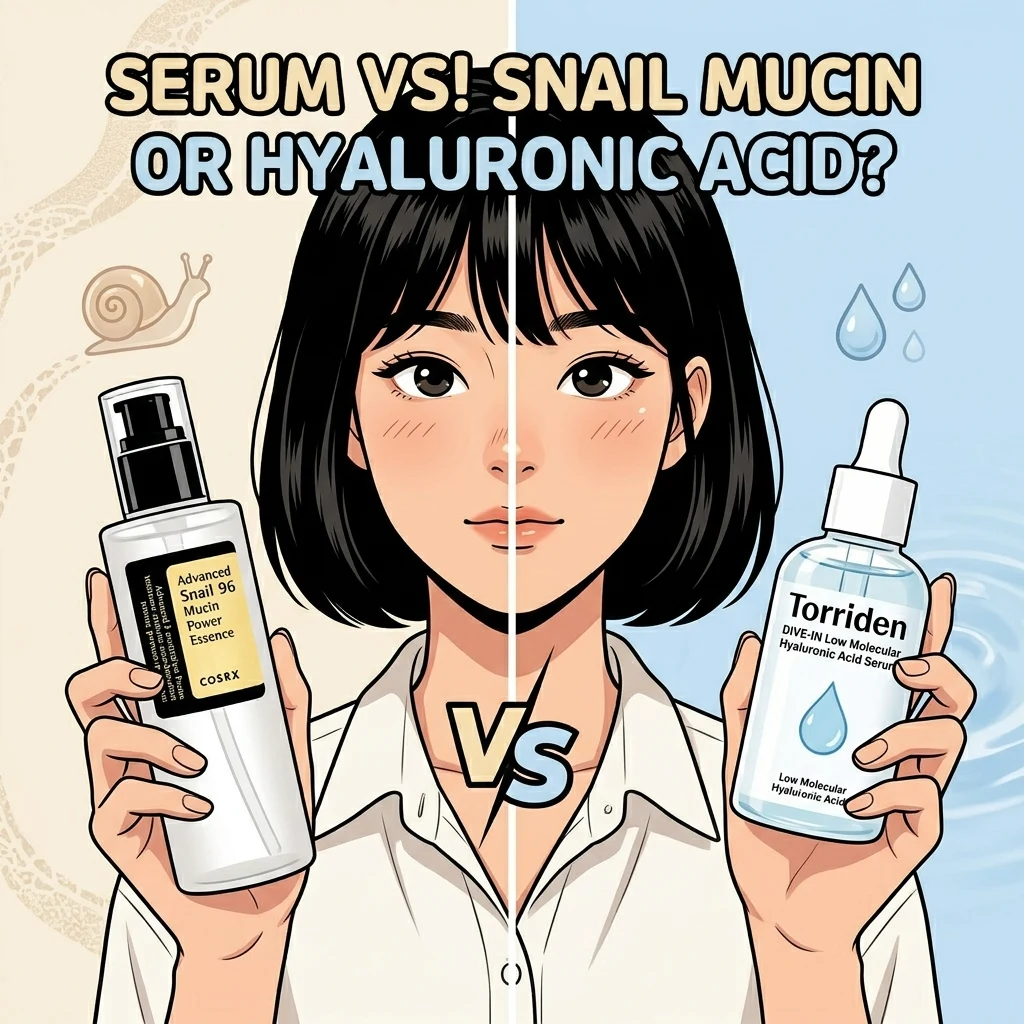
Snail Mucin vs Hyaluronic Acid: At a Glance
| Skin Type | Best Pick | Why |
|---|---|---|
| Dry / Dehydrated | COSRX Snail Mucin | Hydrates AND repairs - HA just hydrates |
| Oily / Combo | Torriden DIVE-IN HA | Lightweight, zero residue, sinks in fast |
| Sensitive / Barrier Damaged | COSRX Snail Mucin | Snail filtrate has wound-healing properties |
| Acne-Prone | Torriden DIVE-IN HA | Non-comedogenic, no snail protein risk |
| Total Beginner | Start with HA → add snail later | Simpler ingredient, fewer allergy concerns |
If you want deeper dives on each product, I did a full COSRX Snail Mucin 96 review and also covered the Torriden in my best Korean serums for 2026 roundup.
Snail Mucin vs Hyaluronic Acid: Feature Comparison
| Feature | Snail Mucin | Hyaluronic Acid |
|---|---|---|
| Hydration | ⭐⭐⭐⭐ | ⭐⭐⭐⭐⭐ |
| Barrier Repair | ✅ Yes | ❌ No |
| Acne-Safe | ⚠️ Check allergy | ✅ Yes |
| Texture | Slightly sticky | Watery, fast-absorb |
| Best For | Dry, damaged, aging skin | Oily, combo, dehydrated |
| Anti-aging | ✅ Yes (allantoin + glycoprotein) | ⚠️ Mild (plumping only) |
| Can Layer Together | ✅ Yes - HA first, then Snail Mucin | |
Snail Mucin vs Hyaluronic Acid: Key Differences Explained
Here's the thing - people talk about these two like they're interchangeable. They're not. Not even close.
Hyaluronic acid is a humectant. That's it. It grabs water molecules from the environment (or deeper layers of your skin) and holds them at the surface. Think of it like a sponge sitting on your face. The Torriden DIVE-IN uses low molecular weight HA, which means smaller molecules that penetrate instead of just sitting on top. That matters - a lot of drugstore HA serums use high molecular weight only, and honestly those barely do anything.
Snail mucin (technically snail secretion filtrate) is a whole cocktail. You're getting glycoproteins, hyaluronic acid (yes, it naturally contains HA), glycolic acid, zinc, and allantoin all in one. The COSRX Advanced Snail 96 Mucin is 96% snail secretion filtrate, and it doesn't just hydrate - it actively helps repair damaged skin cells. There's actual research behind this: snail mucin promotes fibroblast proliferation. In normal words? It helps your skin rebuild itself faster.
So when someone asks "cosrx snail mucin vs hyaluronic acid," they're really comparing a multi-tasker to a specialist.
Snail Mucin vs Hyaluronic Acid: My 8-Week Side-by-Side Test
Yes I did the split-face thing. Left side got the COSRX Snail Mucin, right side got the Torriden DIVE-IN. Same cleanser, same moisturizer, same SPF. Here's what happened:
Week 1-2: Honestly couldn't tell a difference. Both sides felt more hydrated than before. The snail mucin side had a slightly tackier finish that I wasn't obsessed with - like, it wasn't gross, but I was hyper-aware of it every time I touched my face. The HA side absorbed faster and felt like nothing was there - which I liked for morning routines. Under sunscreen, the HA side was noticeably smoother. No pilling, no weird texture. The snail mucin side under sunscreen was fine but required an extra 30 seconds of wait time.
Week 3: This is when it got interesting. I had some redness around my nose from over-exfoliating (classic me), and the snail mucin side calmed down noticeably faster. My coworker asked if I changed my skincare because "your skin looks different." She was sitting on my left side. Coincidence? I think not.
Week 4-5: The HA side was consistently hydrated but that's... all it was doing. The snail mucin side started looking genuinely plumper. Like a subtle glow that wasn't there before. My acne scars on the left cheek started fading faster too, and I wasn't using any actives.
Week 6-8: By the end, the snail mucin side won on texture, glow, and scar fading. The HA side won on consistency and ease - it never irritated, never felt heavy, just reliable hydration every single day. I took comparison photos every Sunday and the week 8 vs week 1 difference was dramatic on the snail mucin side. Pores looked smaller (they weren't smaller, but the smoother texture made them less visible), my PIH from old breakouts had faded maybe 30-40%, and my skin had this inner glow that's hard to describe but you KNOW it when you see it. The HA side looked healthier than week 1 for sure, but the improvement was more subtle - just well-hydrated, even-toned skin without any "wow" factor. If you're building a Korean skincare routine as a beginner, the HA side is the kind of no-brainer product that just works.

COSRX Advanced Snail 96 Mucin Power Essence - Check on Amazon →
Snail Mucin vs Hyaluronic Acid for Dry Skin
If your skin is genuinely dry - like tight, flaky, "my foundation looks like the Sahara" dry - snail mucin wins and it's not close.
Here's why: HA pulls in moisture, but if your skin barrier is already compromised (which it usually is when you're that dry), you need something that hydrates AND repairs at the same time. The COSRX Snail Mucin does both. The glycoproteins and allantoin in snail filtrate actively support barrier repair, so you're not just masking the dryness - you're fixing the root problem.
I'd go as far as saying: don't waste your money on a standalone HA serum if you have chronically dry skin. Get the snail mucin, layer a good moisturizer on top, and call it a day. If you want the full routine, check out my Korean skincare routine for dry skin guide.
Snail Mucin vs HA Serum for Oily and Combo Skin
Plot twist - for oily skin, the Torriden DIVE-IN HA serum is the better pick.
The snail mucin isn't BAD for oily skin, but it has a thicker, more viscous texture that can feel like too much on skin that already produces excess sebum. The Torriden is watery, absorbs in like 10 seconds, and leaves zero film. For morning routines especially - under sunscreen, under makeup - the HA serum is just more practical.
Plus, oily skin is usually not barrier-damaged in the same way dry skin is. You don't need the repair benefits as much. You just need hydration without the weight. The Torriden does exactly that. I tested it specifically on my oiliest days in summer - 90°F, humid, skin producing oil like it was getting paid for it - and the HA serum still didn't make me look greasy. Can't say the same for the snail mucin, which added a dewiness that crossed into "are you sweating?" territory on those days.
If your skin is combo (oily T-zone, dry cheeks) - honestly? Use both. Snail mucin on the dry areas, HA everywhere. That's what I do now and my skin has never been more balanced.
Snail Mucin vs Hyaluronic Acid for Sensitive Skin
I need to be real about this one: the snail mucin girlies are NOT wrong when they say it saved their barrier.
After I destroyed my moisture barrier with tretinoin (again, classic me), the COSRX Snail Mucin was the only thing that didn't sting. Everything else - including HA serums - felt slightly irritating on my raw skin. The snail mucin felt like a cool, soothing blanket.
The science backs this up. Snail secretion filtrate contains copper peptides and growth factors that help compromised skin recover faster. Multiple studies have shown it accelerates wound healing and reduces transepidermal water loss (TEWL) - which is basically a fancy way of saying it stops your skin from leaking moisture. For post-procedure skin, retinol burn, over-exfoliation aftermath, or just general sensitivity, I'd pick snail mucin every single time. I've recommended the COSRX Snail Mucin to three friends recovering from laser treatments and all of them texted me saying their skin healed faster than their derm expected.
One caveat: if you're sensitive AND have a known allergy to latex, shellfish, or dust mites - snail mucin might trigger a reaction. More on that below.
Snail Mucin and Hyaluronic Acid Together: Layering Guide
Yes, and honestly this is the move. Using just one is fine, but using both is where you really see results. Here's exactly how I layer them:
- Cleanse as usual
- Toner on damp skin
- Torriden DIVE-IN HA Serum - 2-3 drops, pat in on damp skin (this is crucial - HA needs water to work with)
- COSRX Snail Mucin - 2 pumps, pat over the HA layer
- Moisturizer to seal everything in
The order matters: HA first (thinnest, most watery), snail mucin second (thicker, more viscous). The HA pulls moisture in, the snail mucin adds its repair benefits and helps lock the hydration. Together they're genuinely better than either alone.
I do this routine morning and night. If you're building out a full routine, my beginner Korean skincare guide walks through every step.
What Reddit Says: Snail Mucin vs Hyaluronic Acid (Real Opinions)
I spent way too long in r/SkincareAddiction and r/AsianBeauty rabbit holes for this. Here's the real consensus:
On snail mucin:
- "COSRX snail mucin is the one product I will never stop repurchasing. My skin glows." - r/AsianBeauty, 2.4k upvotes
- "I was skeptical about putting snail goo on my face but after 3 weeks my texture improved more than with any vitamin C" - r/SkincareAddiction
- "Saved my skin after accutane. Nothing else was gentle enough." - r/AsianBeauty
- Multiple people warned about breakouts in the first week - likely purging or sensitivity to snail protein
On hyaluronic acid:
- "I live in Colorado and HA made my skin DRIER. Switched to snail mucin and the difference was insane." - r/SkincareAddiction (this comes up A LOT)
- "Torriden DIVE-IN is the only HA serum worth buying. Everything else is overpriced water." - r/AsianBeauty
- "HA under moisturizer on damp skin changed my entire routine" - r/SkincareAddiction
- "If you live in a humid climate HA is a cheat code. Dry climate? Stay away." - r/AsianBeauty
The Reddit verdict is pretty clear: snail mucin for repair and glow, HA for pure lightweight hydration - but only if you live somewhere with decent humidity. The dry climate thing comes up in basically every HA thread at this point, and it's probably the most important factor nobody considers before buying. If you're in the southwest US, you need to know this before you spend money on an HA serum that might work against you.
One more thing I noticed in the threads: people who use both products together almost never go back to using just one. The combo keeps getting called a "cheat code" and honestly after my own test, I get why.
Who Should NOT Use Snail Mucin
This doesn't get talked about enough. Snail mucin is amazing, but it's not for everyone:
- Latex allergy: Snail secretion contains proteins that can cross-react with latex allergens. If you have a latex allergy, patch test VERY carefully or skip entirely.
- Shellfish allergy: Similar cross-reactivity risk. The proteins in snail mucin share structural similarities with shellfish allergens.
- Dust mite allergy: This one surprises people, but snails and dust mites share certain allergenic proteins. If you're highly allergic to dust mites, proceed with caution.
- If you broke out from it before: Some people's skin just doesn't vibe with snail protein. That's not a purge - that's your skin saying no. Listen to it.
If any of this applies to you, the Torriden DIVE-IN is a perfectly solid alternative - or check out the Mixsoon Bean Essence for another gentle hydration option.
Who Should NOT Use Hyaluronic Acid
The HA hype train has a dark side that nobody talks about:
- Dry climates (under 40% humidity): This is the big one. HA is a humectant - it pulls moisture from wherever it can find it. In humid environments, it pulls from the air. In dry environments? It pulls moisture OUT of your deeper skin layers. Yes, your hydrating serum can dehydrate you. Colorado, Arizona, heated indoor air in winter - all problem zones.
- If you apply it on dry skin: HA needs water to work. Applying it to a dry face is basically useless at best, counterproductive at worst. Always apply on damp skin.
- High molecular weight only formulas: A lot of cheap HA serums use only high molecular weight hyaluronic acid, which can't penetrate the skin. It sits on top, creates a film, and does almost nothing. The Torriden uses low molecular weight for a reason - it gets in there.
- If you're not sealing it: HA without a moisturizer on top is like filling a bucket with holes. The water will just evaporate. You NEED an occlusive layer after.

Torriden DIVE-IN Hyaluronic Acid Serum - Check on Amazon →
Honest Cons: What I Don't Love About Each
I'm recommending both of these products but let me keep it real:
COSRX Snail Mucin cons:
- The texture is genuinely slimy. You get used to it, but the first few times? Ick factor is real.
- Takes longer to absorb than HA - not ideal if you're rushing in the morning
- The allergy risk is real and under-discussed
- Can feel heavy/sticky in summer or on oily skin
- Results take 3-4 weeks to really show - you need patience
Torriden DIVE-IN HA cons:
- It ONLY hydrates. No repair, no brightening, no anti-aging. It does one thing.
- The dry climate problem is serious and not fixable by just "applying on damp skin"
- Can pill under certain sunscreens if you use too much
- The hydration doesn't last as long as snail mucin - you might need to reapply midday
- Goes through bottles fast because the consistency is so watery
Snail Mucin vs Hyaluronic Acid for Beginners: Which Should You Start With?
If you're just starting your Korean skincare journey and you can only buy ONE product - get the HA serum first.
Here's my reasoning: HA is simpler. It has basically zero allergy risk, works on every skin type (as long as you follow the rules), and the learning curve is flat. Apply on damp skin, moisturize after, done. The Torriden DIVE-IN is especially good for beginners because it's fragrance-free, minimal ingredients, and won't overwhelm skin that isn't used to a multi-step routine yet.
Once you've used HA for a month or two and your skin is comfortable, THEN add the COSRX Snail Mucin on top. This way you can tell exactly what each product is doing for your skin, and if you react to the snail mucin, you'll know immediately.
Final Verdict: Snail Mucin vs Hyaluronic Acid - Who Wins?
I'm not going to give you a wishy-washy "they're both great!" answer because that helps nobody.
If I could only keep one product forever: COSRX Snail Mucin. It does more things, does them well, and the results compound over time. After 8 weeks, my snail mucin side had better texture, better glow, and faster scar healing than the HA side. It's not even a debate.
But if you have oily skin: Torriden DIVE-IN wins. The weight and texture of snail mucin isn't worth fighting with when HA does the hydration job better for your skin type.
If you have allergies: HA is safer. Full stop.
If you can afford both: Use both. HA first, snail mucin second, moisturizer to seal. This combo is the best hydration stack in K-beauty right now, and I've tried probably 40+ serums at this point.
The snail mucin vs ha serum debate doesn't have to be complicated. Match your skin type to the right product, follow the application rules, and you'll see results within a month. And if you can swing both - just do it. Your skin will thank you.
For more options, check out my full best Korean serums for 2026 list - I ranked everything I tested this year.
FAQ: Snail Mucin vs Hyaluronic Acid
Is snail mucin better than hyaluronic acid?
For most skin types, yes. Snail mucin hydrates AND repairs, while HA only hydrates. But for oily skin or people with snail protein allergies, HA is the better choice.
Can I use COSRX snail mucin and hyaluronic acid together?
Absolutely - and you should. Apply HA serum first on damp skin, then layer snail mucin on top. Finish with moisturizer.
Which should I use first, snail mucin or hyaluronic acid?
In your routine: HA first (thinner consistency), snail mucin second. As a beginner buying your first product: start with HA, add snail mucin later.
Does snail mucin contain hyaluronic acid?
Yes! Snail secretion filtrate naturally contains hyaluronic acid, along with glycoproteins, allantoin, and glycolic acid. That's why it's such a multi-tasker.
Can hyaluronic acid dry out your skin?
In dry climates (below 40% humidity), yes. HA pulls moisture from wherever it can - if there's no humidity in the air, it pulls from your deeper skin layers. Always use it on damp skin with a moisturizer on top.
Is snail mucin safe for acne-prone skin?
For most people, yes - it's non-comedogenic. But some people break out from snail protein. If you're acne-prone, patch test for a week first. If it breaks you out, switch to the Torriden DIVE-IN HA instead.
What's better for anti-aging: snail mucin or HA?
Snail mucin. The growth factors and glycoproteins in snail filtrate support collagen production and cell turnover. HA plumps temporarily but doesn't have anti-aging actives.
Why is my snail mucin pilling?
You're probably using too much or not letting it absorb before your next step. Use 1-2 pumps, pat (don't rub) until mostly absorbed, wait 30 seconds, then apply moisturizer.
Is the Torriden DIVE-IN better than other HA serums?
For K-beauty HA serums, I think it's the best option right now. The low molecular weight formula penetrates, it's fragrance-free, and the ingredient list is clean. Most drugstore HA serums don't compare.
Can I use snail mucin if I'm allergic to shellfish?
Proceed with extreme caution. Snail proteins share structural similarities with shellfish allergens, and cross-reactions have been documented. Patch test for 48 hours minimum, or skip it entirely and use the Mixsoon Bean Essence as an alternative.