
This Missha Cushion Foundation review covers 6 months of daily use with shade No.23 Natural Beige - the most asked-about budget Korean cushion in US K-beauty groups. At $20 it is one-third the price of premium picks like JSM, but the Missha cushion has its own loyal fanbase. Here is the honest verdict, including who should grab this and who should save up for the higher-end options.
If you like MISSHA base makeup but want a tube format, compare my best Korean BB creams on Amazon guide.
If you are starting with Missha because it is budget-friendly, I also compared it in my best Korean cushion foundations on Amazon guide.
Affiliate Disclosure: This post contains affiliate links. If you purchase through my links, I may earn a small commission at no extra cost to you. I only recommend products I use and would recommend - this review is 100% my honest opinion.
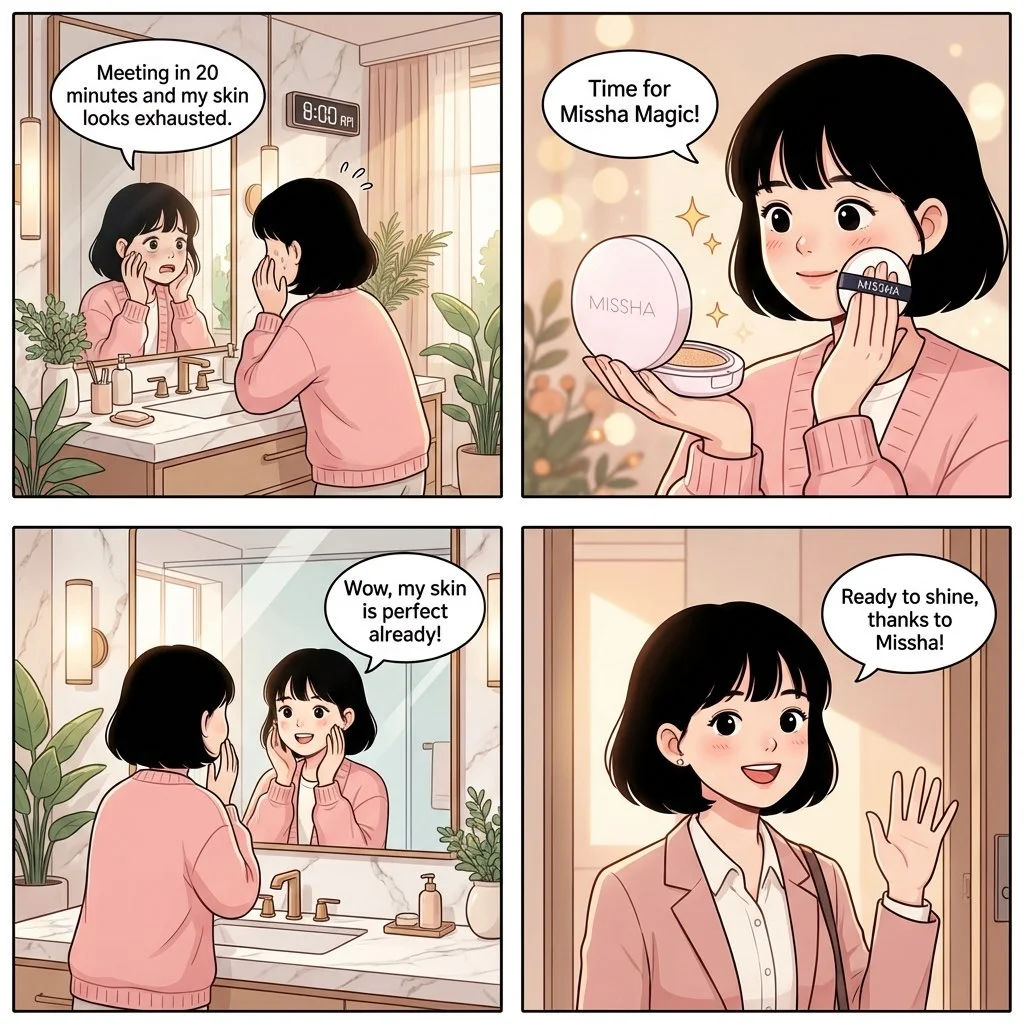
I Bought the Missha cushion for $18 - Here's What Nobody Tells You
Let me tell you exactly how this review started. I was standing in a Missha flagship store in Myeongdong at 7:30 PM on a Tuesday, watching a university student in front of me dab a cushion puff against her cheek like she was patting a very sleepy cat. The result? Flawless. Natural. That thing Koreans call 피부 좋다 - "your skin looks good." Not "your makeup looks good." Your actual skin.
She was using the Missha cushion. And I had walked past it approximately forty times in the past year because $18 felt too cheap to be serious. That was my mistake. A big one.
I've since used this cushion every single day for three months. I've worn it to work presentations, late-night convenience store runs, first dates, and one extremely sweaty open-air concert in Hongdae. I've watched it perform in Seoul's brutal summer humidity and the dry, static-charged air of a Korean winter office building. And now I'm here to tell you everything - not just the basics, but the real stuff: the oxidation question that keeps showing up on Reddit, how it compares to the TIRTIR and Laneige cushions that everyone talks about, and why this particular product has a legacy that most K-beauty TikToks completely ignore.
If you're new to K-beauty cushion foundations and you're not sure where to start, this is your starting point. Not because it's the cheapest. Because it's the one that makes the most sense.
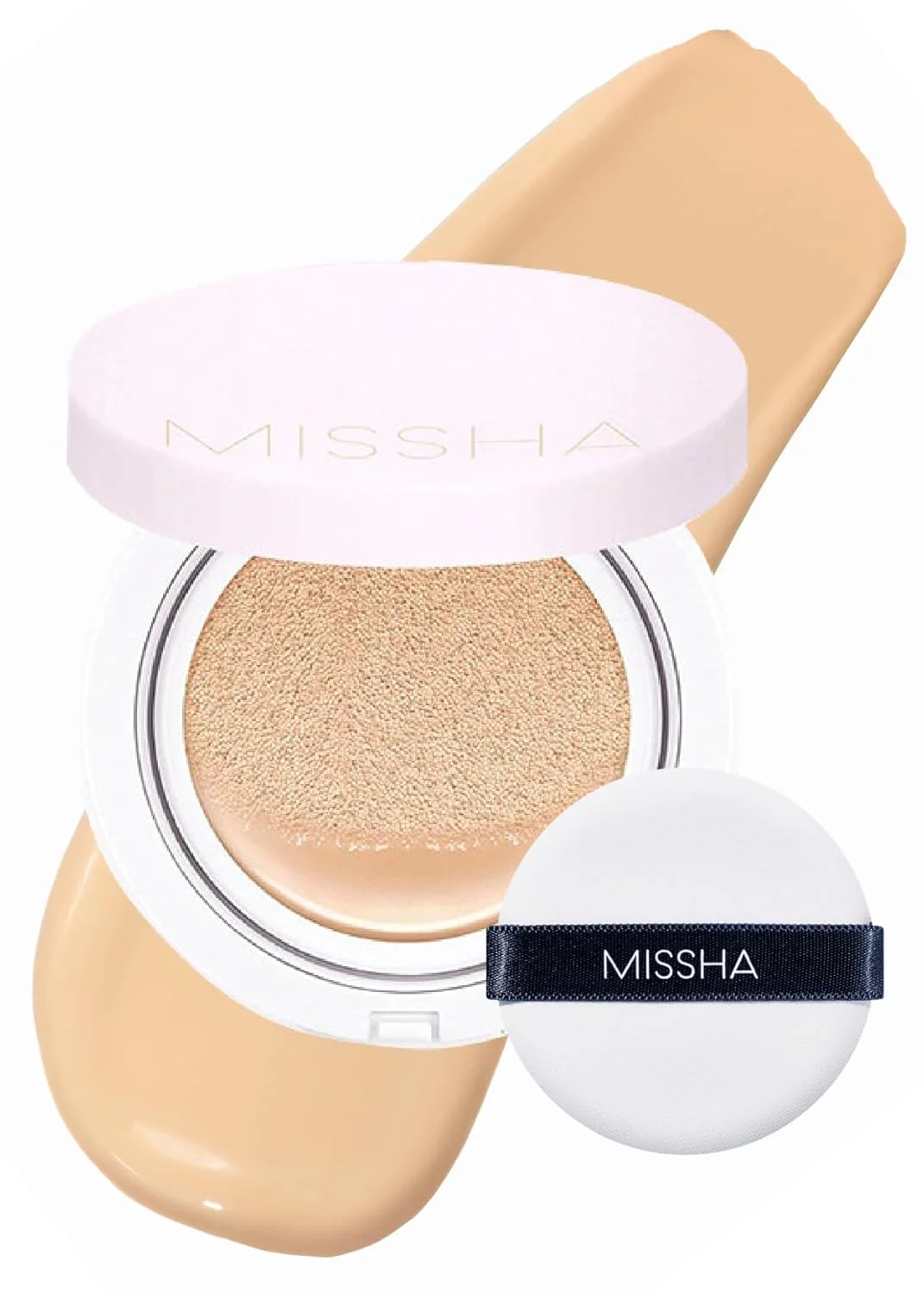
The History Nobody Talks About: Missha Basically Invented This Category
Before we get into swatches and shade matching, I need to talk about something that I think matters a lot for understanding why the Missha cushion exists and why it still sells in 2026 despite every brand launching their own version.
The cushion compact as a foundation delivery format was not always a thing. It sounds obvious now - of course you can put liquid foundation into a sponge-soaked compact. But in 2008, when Missha introduced one of the earliest modern cushion foundations to the Korean market, this was a new idea. The concept was simple but revolutionary: liquid foundation absorbed into a cushion applicator, sealed in a compact, applied with a puff. Fast, travel-friendly, and buildable in a way that traditional powder foundations couldn't match.
What happened next is basically K-beauty history. Korean women went wild for it. The format offered something the Western beauty market had never prioritized in the same way: the ability to get a "glass skin" appearance - not a full-coverage cakey look, but a luminous, skin-like finish - in thirty seconds, with one hand, in the back of a cab. The cushion compact became the defining format of K-beauty's global rise in the 2010s. Amorepacific brands like IOPE and Laneige followed. Sulwhasoo made premium versions. Then every single global brand - Dior, Armani, L'Oréal - started making cushion foundations trying to capture what Korean brands had figured out.
Missha was in the thick of that early wave. The Missha cushion specifically - in its current formulation - is the accessible, no-frills evolution of that original vision. It's not trying to be fancy. It's trying to be good, consistent, and real-world usable. Which, honestly, is exactly what most of us need on a Tuesday morning when we have seventeen minutes to get ready.
When you buy this cushion, you're buying a product that has been refined through nearly two decades of Korean consumer feedback. That's not nothing. That's a lot.
What the Missha cushion Is
Product: Missha Cushion Foundation No.23
Price: ~$18 USD on Amazon
Coverage: Light-to-medium, buildable
Finish: Natural / semi-luminous
SPF: SPF 50+ / PA+++
Size: 15g cushion + 15g refill included
That last point - refill included - is something I want to highlight immediately because it matters for the value calculation. Most cushion foundations at this price point either don't come with a refill or charge extra for it. Missha bundles it in. You effectively get 30g of product for $18. That is aggressively good value, full stop.
No.23 is the shade I use, and it's the most popular one - a light-to-medium neutral with a very slight warm lean. It's designed for what Koreans broadly call "보통 피부" - average skin tone - which in practice means it works for a wide range of East Asian skin tones and also works beautifully for many light-to-medium South Asian, mixed, and Western complexions. I'll talk more about shade matching and the infamous oxidation question in its own section below.
Five Seoul Moments Where This Cushion Just Works
I could give you a lab-style breakdown of this foundation's performance metrics. But honestly, I think the better way to understand a cushion foundation is through situations. Because that's when you really learn what a product can and can't do.
Scene 1: Gangnam Station, 8:40 AM, Monday. The kind of morning where you've already sweated through your first layer of clothes waiting for a transfer. I tapped the puff twice across my T-zone and once across each cheek. Took eleven seconds. Walked into my office looking like I had slept eight hours and owned a full skincare team. The cushion's formula is thin enough to apply over a moisturizer without balling up, and the SPF 50+ means I've skipped a separate sunscreen step on commute days. (Though for actual outdoor days in summer, I still layer a proper sunscreen underneath - more on that in my separate review.)
Scene 2: Bukchon Hanok Village, 2 PM, August. If you've been to Bukchon in August, you know the particular misery of the uphill walk in 34-degree heat with 85% humidity. I wore the Missha cushion with zero primer and zero setting powder. By the time I reached the top, my nose was shiny and my inner corners had migrated slightly. Everything else? Still there. Still looking like skin. The coverage didn't turn patchy. It just got a little dewier, which is honestly an acceptable outcome when the temperature is trying to cook you alive.
Scene 3: Apgujeong coffee shop, Sunday afternoon. The lighting in Korean café spaces is designed by people who want you to feel like you're in a high-resolution photograph. Ring lights everywhere. Huge windows. Reflective surfaces. I checked my face in the bathroom mirror after three hours and the Missha cushion looked exactly as natural and undetectable as when I applied it. No oxidation line. No separation. No weird gray cast in the photos my friend kept taking of my coffee. This is where the formula earns real respect.
Scene 4: Hongdae, 10 PM, standing concert. Outdoor venue. LED lights flickering everywhere. People dancing close enough that you're basically sharing body heat. I reapplied once during a break, two quick taps over my cheeks where the coverage had worn down. The refill compact in my bag made this effortless - no worrying about running out, no fumbling with different products. One product, one step, one minute. Got back to the crowd looking fresh.
Scene 5: Itaewon market, Saturday morning, hungover. I am going to be honest. There was a night. There was a morning. I applied the Missha cushion in approximately ninety seconds in a bathroom with bad lighting and left the house feeling deeply uncertain about my choices - all of them, including last night's. By the time I was sitting at a market table with sundubu jjigae and coffee, I looked at my reflection in the side of a metal thermos and thought: okay. We are fine. That gentle semi-luminous finish does something forgiving with tired skin that heavier foundations never manage. It doesn't sit in dry patches. It doesn't emphasize texture. It just makes your skin look like your skin, but rested.
Texture, Finish, and Application - What You Need to Know
The formula is lightweight and slightly watery - not thick, not gel-like, not the dense cream consistency of some premium cushions. When you press the puff into the cushion and then press it against your skin, the product sheers out naturally and blends without effort. This is important for beginners: there is almost no learning curve here. You cannot really apply this badly. The formula does the work.
The finish is natural semi-luminous - what Koreans describe as 생기 있는, meaning "full of life" or vitality. It's not glassy the way a high-end cushion might be. It's not matte. It sits somewhere in the middle that reads as healthy skin rather than made-up skin, which is exactly the K-beauty finish that international audiences fell in love with.
Coverage is buildable from sheer to light-medium. One application gives you a skin-tint level of coverage - redness evened out, minor spots slightly covered, overall tone unified. Two applications gets you to something closer to genuine light-medium coverage. I've never managed to push it to full coverage, and I wouldn't try - that's not what this formula is built for. If you need full coverage, you need a different product. If you need "I look polished but also definitely have a real face," this is your product.
For application, I always start at the center of my face and work outward with a patting motion - not dragging, not circular buffing. Patting gives you better coverage deposit and prevents the formula from going streaky. The puff that comes with the product is decent quality, but I've also used my regular beauty blender dampened slightly and gotten a slightly more diffused finish. Both work. Neither is wrong.
Setting powder is optional. I use the Innisfree No-Sebum Mineral Powder over my T-zone in summer, and in winter I skip setting powder entirely and let the natural finish breathe. For oily skin types, I'd strongly recommend a powder step - the cushion alone will not hold on truly oily skin for eight hours. For dry or combination skin, you may not need anything on top.
Does Missha cushion Oxidize or Look Orange? (The Reddit Question, Answered)
This question comes up constantly on r/AsianBeauty and r/MakeupAddiction, and I want to answer it properly because the short answers you find in the comments are often incomplete.
Does the Missha cushion oxidize? Yes, mildly. Almost all foundations with certain pigment and emollient combinations will shift slightly warmer after application as they interact with your skin's natural oils and temperature. The Missha cushion is no exception. In No.23, I've observed a subtle warmth shift over the first twenty to thirty minutes of wear - not dramatic, not orange, but enough that if you're shade-matching in-store and checking immediately after application, you might want to wait a few minutes before deciding.
Does it look orange? On my complexion - NC15-20 in MAC terms, fairly neutral-to-warm - it does not look orange. It looks natural. I've seen reports from people with cooler undertones who find the No.23 shade slightly too warm for them. If you have distinctly cool or pink undertones, No.21 might be worth trying first, or you might prefer a different formula entirely. The shade range for this particular product is limited (21, 23, and a couple of deeper options), so if you're outside the light-medium range, your options narrow quickly.
The oxidation vs. flashback question: Several Reddit posts confuse oxidation with SPF flashback in photos. These are different things. Flash photography can make high-SPF products (especially those with physical filters like zinc oxide or titanium dioxide) appear chalky or white in photos. The Missha cushion has SPF 50+ with a mix of chemical and physical filters, so in flash photography at very close range, there may be some minor flashback. This is not the same as the foundation "oxidizing orange." In natural light and indoor lighting, both of which cover the vast majority of your actual day, this product photographs normally.
My practical advice: Swatch No.23 on your inner wrist or jawline. Check it immediately, then again after 30 minutes. If it's within one shade of your actual skin at the 30-minute mark, you're good. If it's reading warm by that point, go one shade lighter to compensate for the oxidation shift.
Missha cushion for K-Beauty Beginners: Why This Is Your Starting Point
I want to talk specifically to people who are new to K-beauty foundations, because there is a particular kind of overwhelm that happens when you start looking at cushion foundations for the first time. There are dozens of options. Price points from $15 to $65. Marketing language that ranges from "glass skin" to "skin care as makeup" to "36-hour wear" to "like air on your face." It's a lot.
Here's my argument for why the Missha cushion is the right first K-beauty cushion foundation for most people:
The learning curve is almost zero. Unlike some cushion foundations that require specific technique, specific primer, or specific setting products to perform well, the Missha cushion works with basic patting application on clean moisturized skin. You don't need to figure out a lot before it starts working. This matters enormously if you've never used a cushion before and you're figuring out the format simultaneously with the product.
The price protects you from over-investment. At $18 with a refill included, if you try this and cushion foundations turn out not to be your thing, you've spent $18. Discovering that you don't like the format after buying a $55 Laneige cushion feels different. Start here. Learn here. Then upgrade if you want to.
The finish teaches you what K-beauty foundation aims for. Western foundations have often been designed around coverage as a primary value - conceal, correct, transform. K-beauty cushion foundations are designed around the idea that your skin should still look like skin, just more unified and glowing. If you've only ever used heavy Western foundations, wearing the Missha cushion for the first time can feel strange - like you haven't done enough. But after a week you start to understand what "skin that looks healthy" means as a makeup goal, and you stop reaching for heavy coverage out of habit rather than need.
It pairs beautifully with a basic K-beauty skincare routine. If you're building a K-beauty routine alongside exploring K-beauty makeup, this cushion rewards good skincare. The better your skin condition - hydration, barrier health, minimal active breakouts - the better this cushion looks. Products like COSRX Snail Mucin 96 underneath make this cushion look smooth and radiant. It creates a feedback loop where you care more about your skin because you can see the difference it makes in how your makeup looks.
SPF 50+ and Why It Matters More Than You Think
Korean beauty culture takes sun protection extremely seriously - far more seriously than most Western beauty cultures have traditionally done. The inclusion of SPF 50+ / PA+++ in a foundation isn't a marketing add-on. It reflects a genuine cultural philosophy that sun protection is the single most effective anti-aging intervention available, and it should be as frictionless and accessible as possible.
The Missha cushion's SPF 50+ is not a substitute for a dedicated sunscreen - dedicated sunscreens still matter for proper coverage and reapplication protocols. But the built-in sun protection in the cushion means that even on days when your routine is shortened or interrupted, you're not going completely bare. For commutes, indoor workdays, and quick errands, the SPF in this cushion is meaningfully protective.
PA+++ also means strong protection against UVA rays - the ones responsible for photoaging, hyperpigmentation, and long-term skin damage. In Korea, PA ratings are taken as seriously as SPF numbers. A cushion with SPF 50+ / PA+++ is legitimately protective, not just labeled for aesthetics.
How to Layer This With Other K-Beauty Products
The Missha cushion works in the makeup step of a Korean routine, which typically means: cleanser, toner, essence or serum, moisturizer, sunscreen, cushion foundation, then optional setting powder or blush/contour. Here's what I've learned about what layers well with it and what doesn't.
Works beautifully: Watery essences and lightweight serums underneath. The COSRX Snail Mucin 96 gives the cushion a particularly glowy base. Lightweight gel moisturizers. A thin layer of sunscreen that has fully absorbed and dried down before application. The Innisfree No-Sebum Mineral Powder set on top for longevity.
Works less well: Heavy, occlusive creams directly before application - these prevent the cushion from setting properly and cause it to slide. Skin that is still actively wet from toner - let everything absorb for at least two to three minutes before applying. Silicone-heavy primers can create a surface that the watery cushion formula doesn't grip well.
For combo-oily skin: The formula will hold better if you apply to skin that's been blotted slightly (not stripped, just not actively dewy) and then set with a powder across the T-zone. Reapply the cushion as a top-up during the day rather than trying to get maximum coverage on the first application - it'll look more natural and last longer.
For dry skin: Apply to well-moisturized skin and let the natural semi-luminous finish do its work. Setting powder is probably unnecessary and may flatten the finish you're going for. Focus on skincare hydration underneath rather than technique on top.
My Honest Pros and Cons After Three Months
I've worn this foundation in enough different situations now that I feel like I've earned an opinion about it. Not just "I tested it for a week and wrote a review," but used it in real life, in Seoul, across seasons and moods and situations I didn't plan for.
What I love:
The skin effect is real, not just marketing language. Every time I wear this, someone somewhere in my life says something along the lines of "your skin looks good today" - not "your makeup looks good." That is the specific achievement of a K-beauty cushion done right, and the Missha gets there at $18. I've worn $45 cushions that couldn't do that.
The refill system is useful. The fact that you get two 15g cushions means you have more than enough product to figure out how to use it properly, make mistakes, reapply generously, and still have product left. You're not rationing from day one.
The SPF 50+ / PA+++ protection is legitimately high. I've simplified my morning routine by about four minutes just from not having to layer a separate sunscreen on casual days. That compounding time savings across a year is more meaningful than it sounds.
Touch-ups are completely seamless. Unlike powder foundations or some liquid-over-powder situations, pressing the Missha cushion puff over slightly worn coverage doesn't look cakey or layered. It blends invisibly with what's already there. This is a real-world feature that I undervalued before I experienced it.
The compact is travel-friendly. Flat, light, doesn't leak, and the cushion format means no pumps to break or caps to lose. It lives in my bag and I don't think about it until I need it.
What I wish were different:
The shade range is limited, and I can't pretend otherwise. If you're not in the light-to-medium range, this product doesn't have many options for you. This is a real gap in the line, and I hope Missha addresses it in future versions. It's the biggest limitation for recommending this to a broader audience.
On oily skin, longevity drops significantly without help. I can get about four to five hours before meaningful fading on my forehead and nose. With the Innisfree powder set on top, that extends to six to seven hours. But if you're oily and you want no-touch all-day wear, this foundation is going to require a supporting cast to deliver that.
The coverage ceiling is real. I have a small dark spot that gets covered to about 60-70% - visible if you're looking, invisible at normal social distance. If that bothers you, you'll want to spot-conceal before applying. The cushion isn't going to rescue you from a day when you need actual coverage. Think of it as a skin enhancer, not a corrector.
The moist finish isn't for everyone. If you strongly prefer a matte finish, this is categorically the wrong product. There's no matte version of this formula. You can set it with powder to reduce shine, but the underlying finish is always going to be natural-to-dewy. Some people don't like that. That's valid.
Missha cushion vs TIRTIR Mask Fit Red vs Laneige Neo Cushion
Since these three cushions are the ones that come up most often in comparison conversations - across Reddit, Korean beauty forums, and in comments on my posts - I want to put them side by side properly. I've used all three extensively.
| Feature | Missha cushion | TIRTIR Mask Fit Red | Laneige Neo Cushion |
|---|---|---|---|
| Price (approx.) | ~$18 | ~$28-$32 | ~$38-$42 |
| Coverage | Light-Medium (buildable) | Medium-Full | Light-Medium (buildable) |
| Finish | Natural / semi-luminous | Satin / skin-like | Dewy / glassy |
| SPF | SPF 50+ / PA+++ | SPF 40+ / PA+++ | SPF 50+ / PA++++ |
| Shade range | Limited (4-5 shades) | Excellent (40+ shades) | Good (15+ shades) |
| Refill included | Yes (15g + 15g) | No (15g only) | No (15g only) |
| Longevity (oily skin) | 4-5 hrs without powder | 6-7 hrs | 5-6 hrs |
| Beginner-friendly | Very high | High | Medium (requires good base) |
| Oxidation tendency | Mild warmth shift | Minimal | Very minimal |
| Best for | Budget-conscious / beginners | Coverage seekers / wide shade range | Glass skin / dry skin types |
My honest read on this comparison: if you're a beginner and you're not sure whether cushion foundations are going to be your thing, start with the Missha. If you know you like cushions but you need better shade options or more coverage, the TIRTIR Mask Fit Red is worth the extra $10-$14 - its shade range is strong and the coverage is in a different league. If you have dry skin, you care deeply about a glassy finish, and you're willing to pay for it, the Laneige Neo Cushion delivers an experience that the Missha simply can't match at that end of the finish spectrum.
If you're curious about a step up from the Missha while staying in the cushion category, my full review of the Jung Saem Mool Essential Skin Nuder Cushion goes into detail about what a premium cushion foundation can do differently - if that $48 price tag is something you're considering.
The OG Legacy Factor: Why Long-Time Users Keep Coming Back
Something worth acknowledging: there are people who have been using the Missha cushion for five, seven, ten years. Not because they haven't tried other products - but because they keep coming back. I've seen this pattern in enough Korean beauty forums and in conversations with makeup artists in Seoul that it feels worth exploring.
Part of it is reliability. When you've used a product long enough that you know exactly how it will behave in every situation - in summer, in winter, over oily skin, over dry skin, freshly applied, hours in - there's a comfort in that predictability that newer or more complicated products can't offer. The Missha cushion doesn't surprise you. It does what it does, every time.
Part of it is the refill economics. Over time, the cost-per-application of this cushion compared to premium alternatives is noticeable. If you're someone who uses a cushion every single day, the difference between $18 (plus inexpensive refills) and $40+ per compact adds up to hundreds of dollars annually. For a product that delivers 80% of the experiential quality at 40-45% of the price, many users make a rational decision to stay.
And part of it is simply that Missha has kept the formula good without trying to over-engineer it. Every product category has versions that get more and more complicated as brands try to differentiate - adding peptides, ceramides, "skin-care infused" claims, biomimetic ingredients - until the original clean simplicity gets lost. The Missha cushion has stayed, more or less, a great cushion foundation that does what cushion foundations do well. That clarity of purpose is underrated in a market that constantly rewards novelty.
Who Should Buy This and Who Should Skip It
Buy this if:
You're new to K-beauty cushion foundations and you want to understand the format without committing $40+ to a first experiment. This is the right entry point - low stakes, high reward if it works for you, minimal loss if it doesn't suit your skin type or finish preference.
You want a quick, every-morning foundation that takes fifteen seconds to apply and looks natural all day for normal-to-dry skin. If your routine is usually rushed and you need something that does the work without requiring technique, this is precisely that product.
You prefer a natural or semi-luminous finish over matte. The Missha cushion's best quality - that "skin that looks alive" quality - only works if you want that finish. If you do, you'll love it immediately.
You're light-to-medium toned with neutral-to-warm undertones. No.23 in particular is extremely flattering on a wide range of complexions within that range. If you match, this will look like it was made for you.
You want SPF in your foundation and you want it to be meaningful SPF. The 50+ / PA+++ formula here is real protection, not a marketing footnote.
Skip this if:
You need medium-to-full coverage as your baseline. The Missha cushion cannot get there reliably, even with multiple layers. You need a different formula - the TIRTIR Mask Fit Red is worth looking at if coverage is your primary requirement.
You have very oily skin and you refuse to use setting powder. Without a powder step, this will not last on high-oil skin for a full workday. That's not a formula flaw - it's just the nature of a lightweight natural-finish cushion. But if that's a dealbreaker, know it going in.
You're outside the limited shade range. If the existing options don't match you, forcing a shade match isn't worth it - foundation that's wrong for your skin tone looks worse than no foundation at all, regardless of how good the formula is.
You strongly prefer a matte finish and find any luminosity uncomfortable or unprofessional. The finish on this product is definitionally not matte, and no amount of setting powder is going to transform the underlying formula into a matte foundation. It's the wrong product for that preference.
Where to Buy
The Missha Cushion Foundation No.23 is available on Amazon for approximately $18, which includes both the compact and a refill. This is one of the most straightforward K-beauty purchases you can make in terms of availability - Prime shipping, easy returns, and you can check the reviews from thousands of actual users before buying. For international readers, Amazon is typically the most accessible and reliable option.
If you're in Korea, it's available in every Missha store location (there are hundreds, including large flagship locations in Myeongdong and Hongdae), on the official Missha website, and on Korean platforms like Olive Young and Gmarket where it frequently goes on sale.
Refills are sold separately and are typically cheaper than the full compact - worth noting because the compact itself (the outer case and puff) lasts indefinitely, and you should only need to replace the cushion insert, not the whole product.
Final Thoughts
The Missha Cushion Foundation is not the most exciting product I've ever reviewed. It doesn't have a story about rare botanical extracts or ten years of fermentation or a celebrity endorsement from someone whose skin I'm fully convinced I could have too if I bought the right things. It's a cushion foundation. It's been a cushion foundation, done well, for a long time. And that's exactly the point.
In a beauty landscape that rewards novelty and narrative above all else, there's something quietly radical about a product that just works, costs $18, and gives you back fifteen minutes of your morning on the days when you don't have fifteen minutes to spare. It's the product that Seoul women were reaching for before the global K-beauty wave made cushion foundations a whole cultural category. It's the product that started the format that Dior and Armani eventually tried to copy. And in 2026, it's still the product I reach for on the mornings when I need to look like I have my life together and I have approximately thirty seconds to get there.
If you're new to K-beauty foundations, start here. If you've been away from K-beauty for a while and you want to come back to something reliable, come back here. If you've already tried the expensive cushions and you're curious whether the original competes - yes. It does. Not at every data point, not in every scenario. But enough. More than enough.
Some things earn their longevity. This is one of them.
Have questions about the Missha cushion or K-beauty cushion foundations in general? Drop them in the comments - I read everything and reply to product questions as fast as I can.